Montbrehain - the Beaurevoir Line - 5th October 1918
The Battle of Montbrehain was the last action involving Australian infantry on the Western Front in the First World War.
Following the breach of the Hindenburg Line at the end of September in 1918, the attack on Montbrehain on 5 October 1918 finally broke the elaborate system of German defences based on the Beaurevoir trench line system.
After the successes of 3rd and 5th Divisions in breaching the Hindenberg line they were taken out of the line to rest. The 6th Brigade of the 2nd Australian Division entered the line for the Battle of Montbrehain.
On the misty morning of 5 October, the assault battalions – 21st and 24th Battalion’s bolstered by Pioneers from 2nd Pioneer Battalion fighting as Infantry – attacked uphill from the little village of Ramicourt across five hundred metres of fire-swept ground. “They scrambled through barbed wire entanglements, captured trenches, cleared dugouts and repeatedly assaulted machine gun positions” according the 24th Battalion Diary. By capturing Montbrehain and holding it against determined German counter attacks the much vaunted Hindenburg Line was completely broken.
The brigade succeeded in occupying the village and in the process took more than 600 German prisoners. The action claimed 430 Australian casualties. The highly successful attack is considered to be one of the greatest Australian actions of the war. The defence of this sector was then handed over to Americans troops, while the Australians, exhausted and depleted, were withdrawn for a rest.
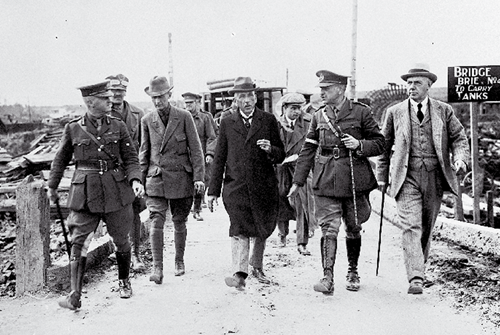
Image:
General Sir John Monash accompanies the Australian Prime Minister, Billy Hughes, over some of the recent battlefields, 14 September 1918. Hughes had been in Europe since mid-1918, and did not return home until after the 1919 Peace Conference. (AWM E03851)